
A handful of pantry ingredients becomes a supple bread through patient resting, careful coiling and a hot pan watched closely. This long-form food story follows the dish from pantry and chopping board to the moment it is shared, with a complete home-kitchen recipe for cooks who want to understand both method and meaning.
In Cape Flats, “Soft roti by hand: the rolling, resting and heat behind every flaky layer” begins from the understanding that recipes are rarely fixed scripts. They travel through families by watching, tasting and repeating: a cook learns how dark an onion should become, how a batter should fall from the spoon, or how steam sounds beneath a sealed lid. Those details are as important as the ingredient list.
“Good community journalism makes space for complexity, dignity and the details of everyday life.”
For “Soft roti by hand: the rolling, resting and heat behind every flaky layer”, the recipe below gives measured quantities and clear timings, but it also names the visual and tactile cues that make the method adaptable. Ingredient strength, cookware and stove heat vary, so the cook is encouraged to taste, observe and make small corrections rather than follow numbers without judgement.
In this Cape Flats food story about “Soft roti by hand: the rolling, resting and heat behind every flaky layer”, family versions will differ, and that variety is part of the dish’s living history. The aim is a dependable starting point: enough context to understand the dish, enough precision to cook it safely, and enough openness for a household to make it its own.
Soft flaky Cape-style roti
Ingredients
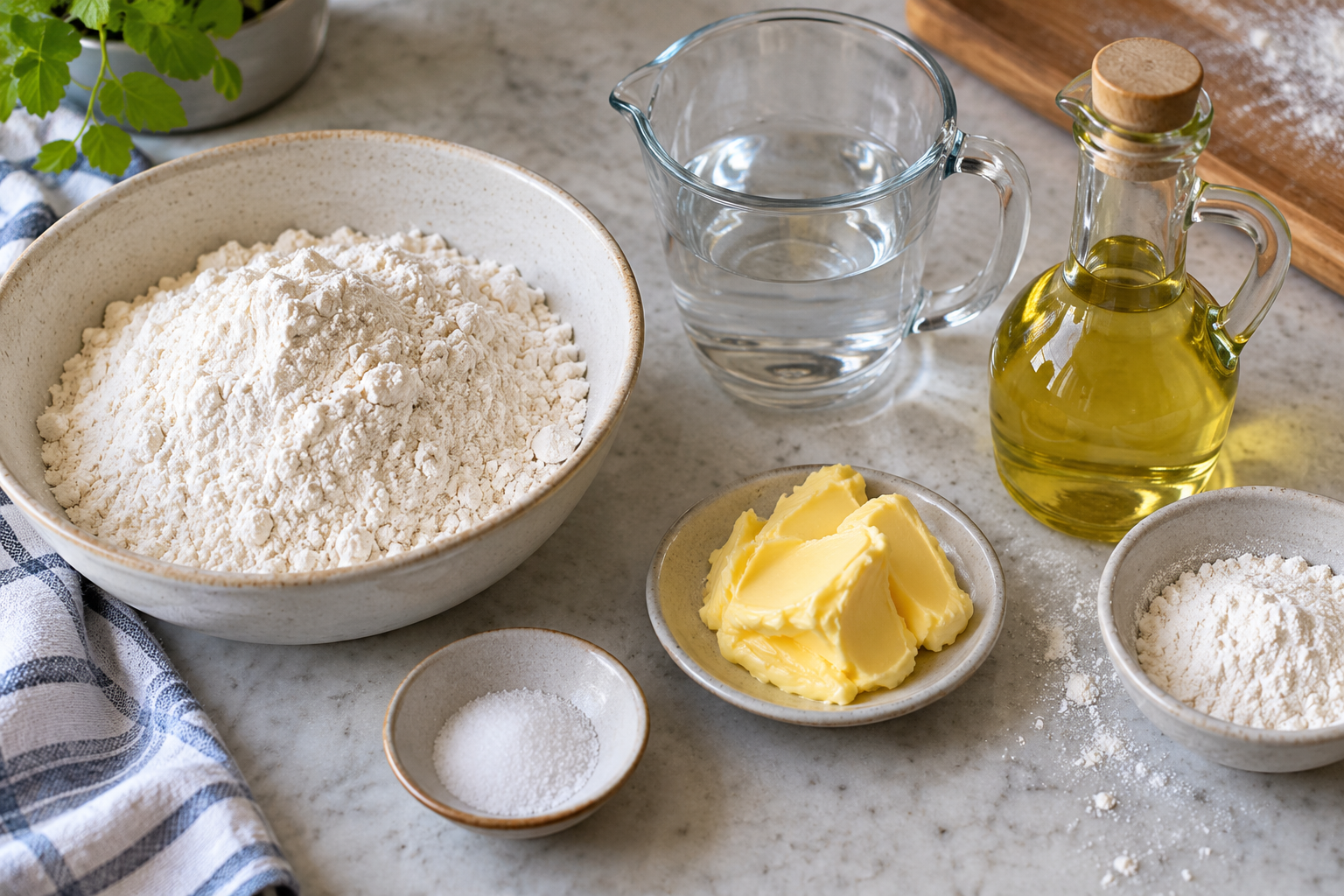
- 600 g cake flour
- 1½ tsp fine salt
- 1 tbsp neutral oil
- 360–400 ml warm water
- 80 g very soft butter or ghee, for layering
- Extra flour, for rolling
- A little neutral oil, for the pan if required
Method
- Combine the flour and salt in a broad bowl. Add the tablespoon of oil and 360 ml warm water, mixing until a shaggy dough forms. Add the remaining water gradually; the dough should be soft but able to leave the sides of the bowl.
- Knead for 8–10 minutes until smooth and elastic. Cover the dough directly so its surface cannot dry and rest for 30 minutes.
- Divide into 12 equal balls. Keep them covered while working. Roll one ball into a very thin circle or rectangle, using only enough flour to prevent sticking.
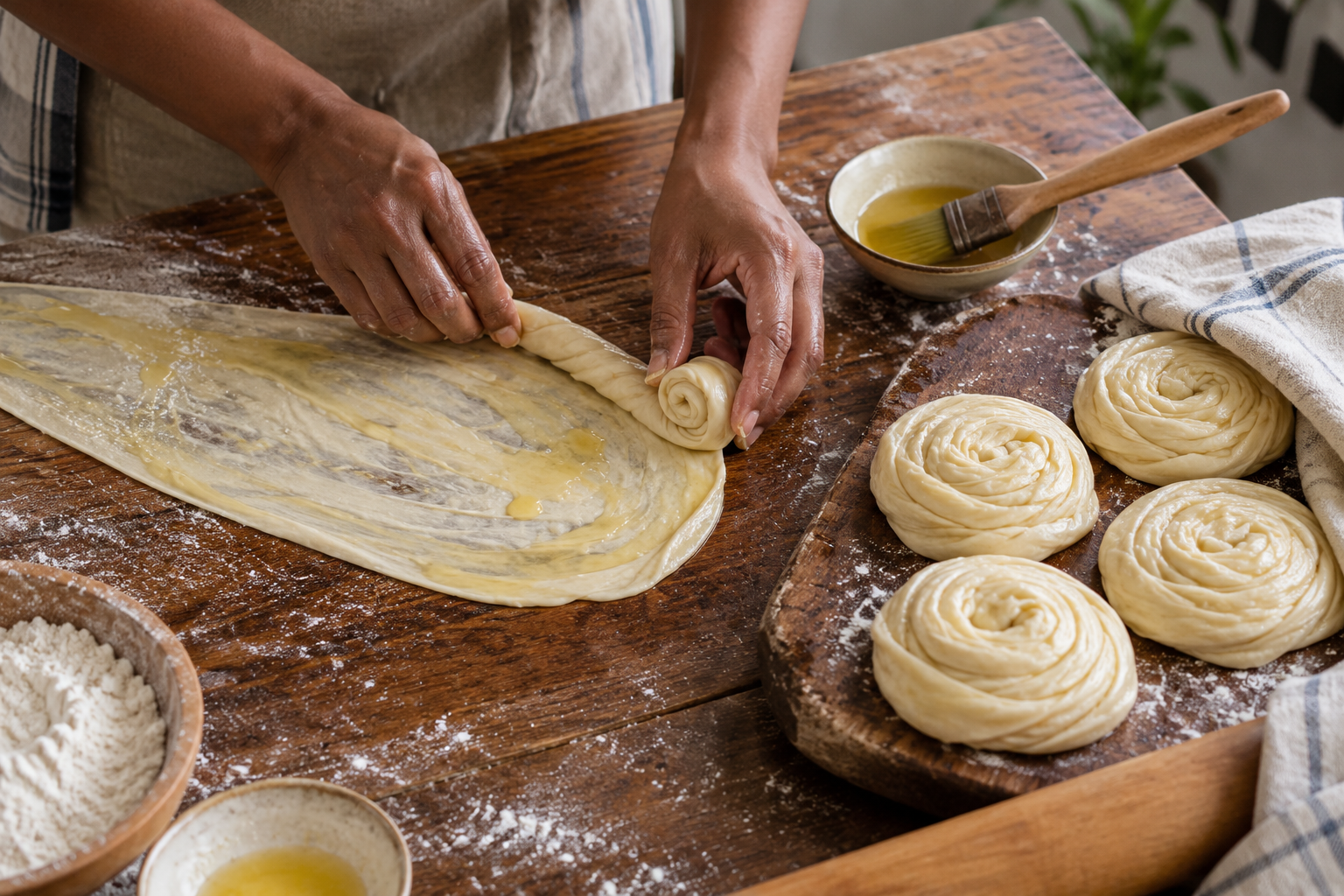
- Spread a thin even layer of soft butter or ghee across the dough. Cut a line from the centre to one edge, then roll the sheet around the centre into a cone; alternatively, roll into a log and coil it tightly. Tuck the end underneath.
- Repeat with the remaining dough. Cover the coils and rest for at least 30 minutes. This second rest allows the gluten to relax and the layers to settle before the final rolling.
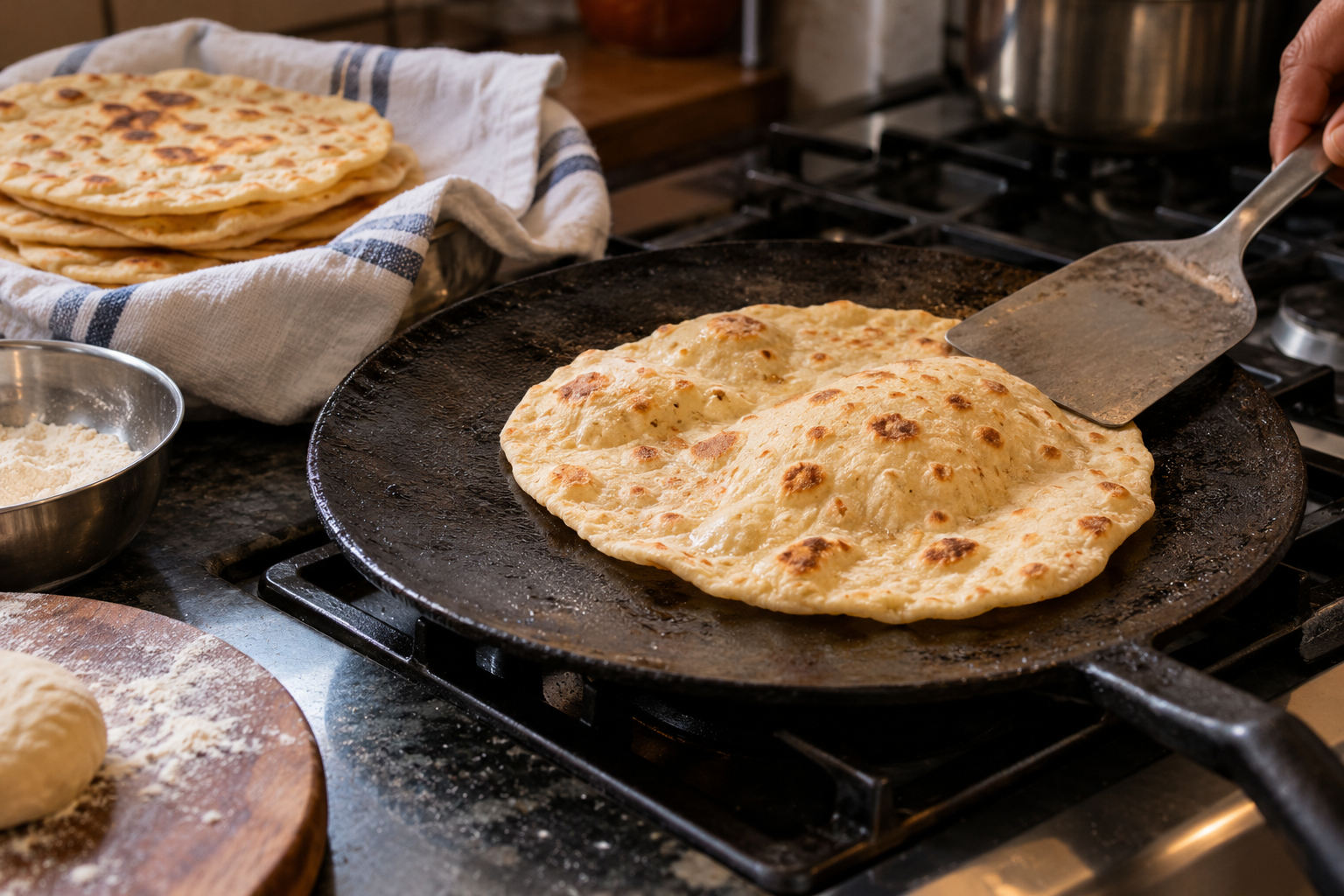
- Heat a flat cast-iron or heavy pan over medium-high heat. Roll one coil into a 20–22 cm round with even pressure, turning frequently so it does not stick or become misshapen.
- Cook for 45–60 seconds until bubbles appear and pale brown spots form underneath. Turn, cook the second side, then turn once more briefly. Adjust the heat if black spots appear before the dough puffs.
- Place each cooked roti in a clean tea towel and keep the stack covered. Clap a small stack gently between protected hands or flex them beneath the towel to loosen the layers before serving.
Simple ingredients make technique visible
In “Soft roti by hand: the rolling, resting and heat behind every flaky layer”, the first principle is understanding how flour, water, salt and fat combine before any rolling or cooking begins. With Soft flaky Cape-style roti, success begins before the heat is switched on: ingredients are measured, vegetables are cut to a consistent size and the pot or pan is chosen with enough room for food to cook rather than crowd. Mise en place is not restaurant theatre here; it gives the home cook time to notice colour, aroma and texture at each stage.
Within Cape Flats, the question at the heart of “Soft roti by hand: the rolling, resting and heat behind every flaky layer”—understanding how flour, water, salt and fat combine before any rolling or cooking begins—makes one point especially clear: sequence matters because ingredients do different work. Aromatics need time to release fragrance, spices need contact with warm fat without scorching, and meat, rice, batter or custard each responds to heat on its own schedule. Adding everything together may look efficient, but it removes the layers that give the finished dish clarity and depth.
Through the section “Simple ingredients make technique visible” in “Soft roti by hand: the rolling, resting and heat behind every flaky layer”, a written time is therefore a guide, not the only evidence. Onion colour, the sound of moisture evaporating and the way a sauce coats a spoon may tell the cook more than a clock. Learning those cues makes the recipe repeatable on another stove, in another pot and with ingredients that behave a little differently.
For this Food account of “Soft roti by hand: the rolling, resting and heat behind every flaky layer”, preparation also protects calm. Reading the full method first reveals where attention cannot be divided and where a pause is possible. That is particularly useful when cooking for family, because the kitchen remains part of a busy home rather than a sealed professional workspace.
Here in “Soft roti by hand: the rolling, resting and heat behind every flaky layer”, understanding how flour, water, salt and fat combine before any rolling or cooking begins is grounded in the particular conditions of Cape Flats: this is why Simple ingredients make technique visible deserves its own place in the story. The visible dish may arrive at the table in one vessel, but its quality is built through a series of small, deliberate decisions. None is dramatic alone; together they create the flavour and texture people remember.
The “Simple ingredients make technique visible” discussion in “Soft roti by hand: the rolling, resting and heat behind every flaky layer” also shows that for a first attempt, it helps to make the stated quantity rather than immediately doubling it. The cook can observe how the mixture moves, where heat concentrates and how long each stage really takes. Scaling becomes safer once those relationships are understood rather than guessed.
Rest gives the dough permission to stretch
In “Soft roti by hand: the rolling, resting and heat behind every flaky layer”, the central technique is using pauses between mixing, dividing and rolling so the gluten relaxes instead of fighting the cook. Spices and seasoning should support the main ingredient, not flatten it beneath undifferentiated heat. Whole spices tend to release aroma slowly, ground spices move quickly, and fresh herbs contribute their clearest character near the end. Treating them as separate tools gives the cook much finer control.
Within Cape Flats, the question at the heart of “Soft roti by hand: the rolling, resting and heat behind every flaky layer”—using pauses between mixing, dividing and rolling so the gluten relaxes instead of fighting the cook—makes one point especially clear: freshness matters. Ground spice that has stood open for months may smell dusty and require more volume without producing more complexity. Buying modest quantities, storing them airtight away from the stove and noting when a blend was opened can improve a dish more reliably than adding extra spoonfuls at the last minute.
Through the section “Rest gives the dough permission to stretch” in “Soft roti by hand: the rolling, resting and heat behind every flaky layer”, salt needs the same attention. Seasoning in stages allows large ingredients to absorb flavour, but reduction concentrates salt as water leaves the pot. A useful habit is to season lightly early, then make the final correction only when the sauce, soup, filling or rice is close to its finished consistency.
For this Food account of “Soft roti by hand: the rolling, resting and heat behind every flaky layer”, heat is an ingredient too. A vigorous flame can create browning, while a gentle one gives tough meat time to soften or starch time to hydrate. Neither setting is automatically better. The important skill is recognising what the current stage needs and adjusting before food catches, splits or dries.
Here in “Soft roti by hand: the rolling, resting and heat behind every flaky layer”, using pauses between mixing, dividing and rolling so the gluten relaxes instead of fighting the cook is grounded in the particular conditions of Cape Flats: when the focus is Rest gives the dough permission to stretch, the cook is building balance rather than chasing intensity. Acidity can brighten fat, sweetness can round sharpness, and a fresh garnish can lift a slow-cooked base. Each adjustment should be small, followed by a pause and another taste.
The “Rest gives the dough permission to stretch” discussion in “Soft roti by hand: the rolling, resting and heat behind every flaky layer” also shows that the recipe’s quantities establish a tested direction, while the sensory cues explain how to remain on course. That combination is especially valuable when teaching: a new cook can measure with confidence and still begin developing the judgement that experienced relatives often use instinctively.
Layers are built deliberately
In “Soft roti by hand: the rolling, resting and heat behind every flaky layer”, texture is governed by brushing, folding and coiling thin dough to create separation without making the finished roti greasy. The finished appearance may attract attention first, but texture is what reveals whether moisture, heat and timing were controlled. Crisp food needs steam to escape; tender braises need moisture to remain; rice needs enough liquid to swell without losing structure.
Within Cape Flats, the question at the heart of “Soft roti by hand: the rolling, resting and heat behind every flaky layer”—brushing, folding and coiling thin dough to create separation without making the finished roti greasy—makes one point especially clear: water is rarely neutral in a recipe. Vegetables release it, yoghurt carries it, soaked grains retain it and a lid traps it. The cook should look at the whole system before adding more. A mixture that seems dry at the start may loosen considerably once salt and heat begin drawing out moisture.
Through the section “Layers are built deliberately” in “Soft roti by hand: the rolling, resting and heat behind every flaky layer”, pan size changes the result. Crowded ingredients cool the cooking surface and steam instead of brown, while an oversized pot may evaporate liquid too quickly. Matching the vessel to the quantity is one of the simplest ways to make the printed timing more accurate.
For this Food account of “Soft roti by hand: the rolling, resting and heat behind every flaky layer”, resting belongs to texture as much as cooking. Rice settles, custard sets, fried food releases surface steam and a braise redistributes its juices. Cutting, stirring or serving immediately can undo careful work from the preceding hour, so the resting time in the recipe should be treated as a real stage.
Here in “Soft roti by hand: the rolling, resting and heat behind every flaky layer”, brushing, folding and coiling thin dough to create separation without making the finished roti greasy is grounded in the particular conditions of Cape Flats: the value of Layers are built deliberately is consistency without rigidity. A cook is not trying to reproduce a machine-made object; the goal is to reach the recognisable character of the dish while responding intelligently to the ingredients at hand.
The “Layers are built deliberately” discussion in “Soft roti by hand: the rolling, resting and heat behind every flaky layer” also shows that if a result is imperfect, the most useful response is specific. “Too wet”, “coloured before the centre cooked” or “needed more acidity” offers information for the next batch. That small kitchen record turns disappointment into technique and prevents the same correction from having to be rediscovered.
The pan must be hot but forgiving
In “Soft roti by hand: the rolling, resting and heat behind every flaky layer”, experienced cooks often rely on cooking quickly enough for bubbles and brown spots while avoiding a hard dry surface. Their shorthand can sound mysterious until it is translated into observable signs: the pitch of frying oil, the scent of toasted spice, the size of bubbles in a thickening custard or the resistance of a grain pressed between finger and thumb.
Within Cape Flats, the question at the heart of “Soft roti by hand: the rolling, resting and heat behind every flaky layer”—cooking quickly enough for bubbles and brown spots while avoiding a hard dry surface—makes one point especially clear: those cues should be learned alongside safe practice. Handles are turned away from the edge, hot oil is never left alone, raw meat is kept separate from ready-to-eat food and cooked dishes are cooled promptly when they will be stored. Tradition and food safety strengthen one another when both protect the people being fed.
Through the section “The pan must be hot but forgiving” in “Soft roti by hand: the rolling, resting and heat behind every flaky layer”, tasting also needs a plan. A filling should be checked before it is enclosed, a pickle before it is poured and a stew after reduction has concentrated its seasoning. Where raw meat is involved, a small portion can be cooked separately for tasting rather than sampling an unsafe mixture.
For this Food account of “Soft roti by hand: the rolling, resting and heat behind every flaky layer”, the cook should know where correction remains possible. Liquid can often be reduced, a thick mixture loosened and final acidity adjusted. Other moments are irreversible: burnt spice cannot be hidden, overcooked fish will not become firm again and dough sealed around wet filling will remain difficult to crisp.
Here in “Soft roti by hand: the rolling, resting and heat behind every flaky layer”, cooking quickly enough for bubbles and brown spots while avoiding a hard dry surface is grounded in the particular conditions of Cape Flats: that practical awareness is the heart of The pan must be hot but forgiving. It replaces kitchen anxiety with attentive decision-making. The cook is no longer waiting for a timer to announce success; they are gathering evidence throughout the process.
The “The pan must be hot but forgiving” discussion in “Soft roti by hand: the rolling, resting and heat behind every flaky layer” also shows that when passing the recipe on, saying these cues aloud is generous. “Cook until done” protects the expert’s knowledge but does not teach it. Describing colour, aroma, movement and touch gives a learner something concrete to practise and eventually recognise without prompting.
Steam is preserved after cooking
In “Soft roti by hand: the rolling, resting and heat behind every flaky layer”, a meal remains sustainable through stacking and covering warm rotis so their layers remain pliable until the curry reaches the table. Shopping begins with a realistic guest count and a check of what is already in the pantry. That prevents duplicate purchases, helps control cost and makes it easier to choose one or two strong accompaniments instead of an exhausting spread.
Within Cape Flats, the question at the heart of “Soft roti by hand: the rolling, resting and heat behind every flaky layer”—stacking and covering warm rotis so their layers remain pliable until the curry reaches the table—makes one point especially clear: work can be divided by what keeps well. Dry ingredients may be measured earlier, onions or herbs prepared at a sensible time, and suitable components chilled or frozen. The aim is not to make food days in advance indiscriminately, but to move safe tasks away from the busiest hour.
Through the section “Steam is preserved after cooking” in “Soft roti by hand: the rolling, resting and heat behind every flaky layer”, serving temperature and holding time matter as much as cooking. Hot food should remain hot, cold food cold, and large quantities should not sit in the uncertain middle for extended periods. Shallow containers, clear labels and a plan for refrigerator space are ordinary tools of generous hospitality.
For this Food account of “Soft roti by hand: the rolling, resting and heat behind every flaky layer”, portioning can be kind rather than restrictive. Offering a moderate first serving leaves room for guests to return and reduces the amount abandoned on plates. Accompaniments can add freshness and contrast without multiplying heavy dishes that compete for oven, stove and attention.
Here in “Soft roti by hand: the rolling, resting and heat behind every flaky layer”, stacking and covering warm rotis so their layers remain pliable until the curry reaches the table is grounded in the particular conditions of Cape Flats: seen this way, Steam is preserved after cooking is not about making the table smaller. It is about directing effort toward food that arrives in good condition and a host who still has energy for the people present. Welcome is felt in attention, not only in quantity.
The “Steam is preserved after cooking” discussion in “Soft roti by hand: the rolling, resting and heat behind every flaky layer” also shows that leftovers deserve an explicit plan. They should be cooled quickly, dated, refrigerated or frozen appropriately and reheated only as needed. Knowing in advance who will use them turns surplus into another meal instead of an invisible cost at the back of the fridge.
The method is learned through the hands
In “Soft roti by hand: the rolling, resting and heat behind every flaky layer”, the lasting value comes from translating pressure, thickness and timing into clear cues that a first-time cook can practise. A useful family recipe records weight or volume, but it also preserves choices: which ingredient may vary, which step cannot be rushed and what the cook should notice before moving on.
Within Cape Flats, the question at the heart of “Soft roti by hand: the rolling, resting and heat behind every flaky layer”—translating pressure, thickness and timing into clear cues that a first-time cook can practise—makes one point especially clear: photographs can help document texture and colour, while a short voice note may capture an explanation more naturally than formal writing. Naming the cook, the occasion and the date gives future readers context instead of presenting one household’s version as the only possible original.
Through the section “The method is learned through the hands” in “Soft roti by hand: the rolling, resting and heat behind every flaky layer”, variation should be recorded honestly. One branch of a family may prefer more heat, another a sweeter finish, and a younger cook may adapt a method for a smaller household. These differences do not necessarily weaken authenticity; they show how a living recipe responds to circumstance.
For this Food account of “Soft roti by hand: the rolling, resting and heat behind every flaky layer”, teaching works best through participation. A learner can begin with one repeatable task, then take responsibility for a complete stage and finally cook the dish with an experienced person nearby. That progression transfers judgement as well as instructions.
Here in “Soft roti by hand: the rolling, resting and heat behind every flaky layer”, translating pressure, thickness and timing into clear cues that a first-time cook can practise is grounded in the particular conditions of Cape Flats: this is the promise behind The method is learned through the hands: the dish remains recognisable while the knowledge needed to make it becomes available to more hands. Precision and inheritance are not opposites. Clear notes can protect the very nuances that vague memory is most likely to lose.
The “The method is learned through the hands” discussion in “Soft roti by hand: the rolling, resting and heat behind every flaky layer” also shows that the final test is the table. Soft flaky Cape-style roti should be satisfying, safe and practical enough to cook again. When people can repeat it, discuss it and adapt it with care, the story continues beyond one article and returns to the place food knowledge has always lived—in use.
Spot something that needs correcting? Tell our editorial team.


